




If you’ve read even a little on the subject, you’ll know that the ideal pressure for espresso is 9 bars. This figure is no coincidence — it stems from the recommendations of the Italian Espresso Institute, which states in its guidelines that 9 bars, with a margin of one bar either way, is the appropriate extraction pressure for espresso, as this pressure ensures “the roundest and smoothest flavor, with acidity and bitterness in balance so that neither prevails over the other, and astringency is absent or barely perceptible.”
But why does extraction pressure have such a strong effect on espresso?
This is how pressure during extraction affects the flavor of your coffee
Technically, what happens at 9 bars is that a more controlled pour is achieved, causing the water to flow slowly and gently, which in turn produces a uniform extraction of all the ground coffee equally — and therefore yields an espresso with that balance and harmony I mentioned before.
Once we exceed 9 bars, that balance breaks down. Far more compounds from the ground coffee dissolve into the water, and due to the increased pressure, the water flow rate also rises. That higher pressure can cause channeling issues in the coffee puck, meaning the extraction is no longer as uniform: some aromas may intensify while others disappear, and as a general rule the espresso turns out more bitter.
It is true that extraction at very high pressure encourages the formation of a thicker, larger crema layer — especially with a longer pull. But this doesn’t necessarily mean a better-tasting espresso. In fact, that crema carries compounds such as oils and fats that, precisely, heighten the perception of bitterness.
The exaggerated trend of manufacturers increasing pump pressure
If we combine what I’ve just explained with the fact that manufacturers have tended in recent years to increase the pressure at which their pumps operate, we find ourselves in a landscape where it is genuinely difficult to find an espresso machine that actually extracts coffee at around those ideal 9 bars.
So what is behind this trend of using 15- or 19-bar pumps? Well, in reality the bar rating listed in the specifications doesn’t mean the machine always operates at that pressure — it is simply the maximum pressure the pump can reach at certain peak moments during operation.
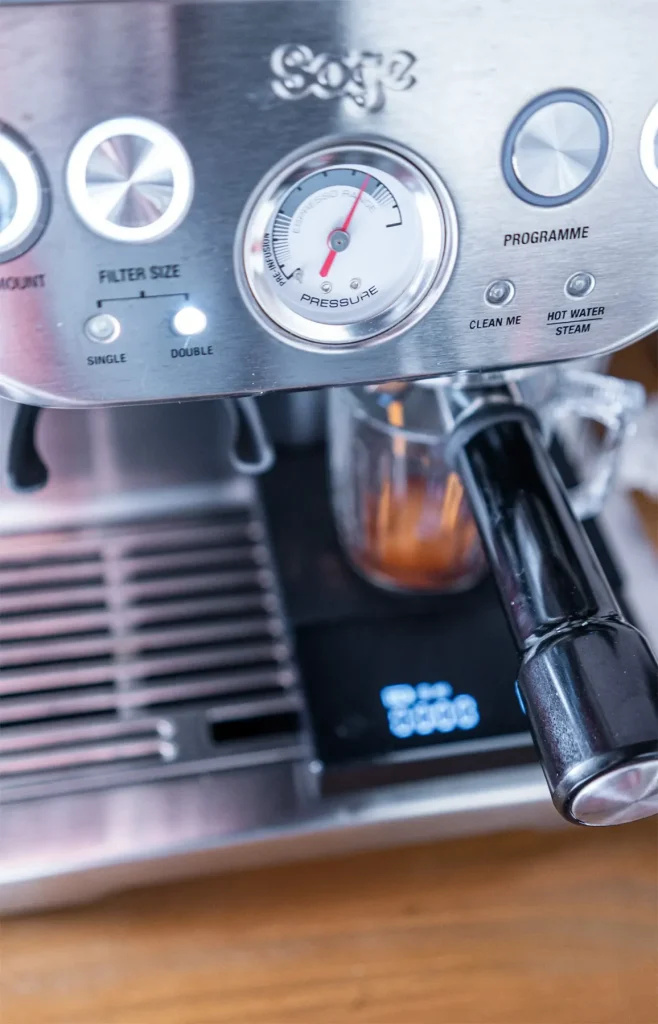
The pumps used in most domestic espresso machines are vibratory pumps, as they are smaller and cheaper. With this type of pump, pressure is not linear: they need to generate more pressure than the theoretical target because some of that pressure is then “lost” through the hydraulic circuit — valves, hoses, heating elements, portafilter, and so on — unlike rotary pumps, which are used in commercial machines and are capable of operating at a constant pressure.
But even if these are only pressure peaks, most of these pumps tend to run above 9 bars, and the main reason is that these machines come fitted with pressurized portafilters that make extraction easier with coarser grinds or coffees that were roasted a long time ago and have therefore lost the freshness needed to work with non-pressurized portafilters.
These portafilters require the pump to operate at high pressures in order to carry out the extraction, and manufacturers ensure this by installing pumps without an over-pressure valve (OPV) to limit pressure to 9 bars — or, if one is present, it is set far too high (12–15 bar). The result: the pump delivers almost its full force directly to the coffee.
This is explained very clearly by renowned espresso specialist James Hoffmann in this video: as pressure rises above that 9-bar reference point, water flow increases, and it becomes harder to control the extraction within the ideal time window of 20 to 35 seconds while achieving the ideal espresso ratio of 1:2.
If you care about the quality of your espresso, you’ll need to open your wallet
Essentially, for all these reasons, there’s no alternative but to dig deep into your pockets if you want to enjoy a truly good espresso. While the most important piece in a barista’s arsenal is the grinder, the machine also matters — ideally, you should look for one with an OPV set to 9 bars (not exceeding 11), or at least one that can be adjusted by the user.
Domestic machines of this kind? Sage/Breville. Though not all of them: it is well known that early models of the Barista Express came with their OPV configured to operate at 13 or 14 bars. From 2022 onwards, Sage corrected this flaw and all models of the machine are now sold with the OPV set to 9 bars, as is the case with other well-known models from the brand, such as the Sage Bambino Plus.
Other brands, such as De’Longhi, do not have their pressure set to 9 bars, but some of their models (the ones I include among my recommended espresso machines) typically do not exceed around 10 or 11 bars, which is within an acceptable range. Another popular machine like the Gaggia Classic Pro comes without an OPV but one can be installed with a simple mod.
Where am I going with all this? I suppose the conclusion is that from now on it’s a good idea to stop worrying about the maximum bar rating the manufacturer advertises, and instead focus on finding out what pressure the machine actually operates at during extraction.
